Being the continuation of InstaPunk and InstaPunk Rules
A Few Thoughts on Foul Language
Get link
Facebook
X
Pinterest
Email
Other Apps
A cartoon stolen from ****ing Alarmy, who always watermark their stuff
There comes a time when you realize some critical cultural variable has reached the kind of tipping point that transforms into chaos. I recently realized one of these tipping points has been reached when the streaming services, desperate for new product in the vacuum left by their failed woke productions, suddenly dumped a bunch of theatrical releases and straight to video movies from the years 2023 and 2024 on their platforms. I watch a lot of movies on streaming services, but I quickly learned not to watch anything dated ‘23 or ‘24. Too much gender confusion nonsense, too much (un)veiled lefty politicking about this and that, but most of all, way way too much foul language. I’d long had a rule that more than 10 F-bombs in 5 minutes was a signal to bail from any movie. Now I knew that this low bar couldn’t be met by the overwhelming majority of movies from the past few years.
I’m not a prig. I probably hold the world record for the number of times a man can say FU to his computer, and I don’t apologize to my wife when I do that because it would cost even more time than the computer has just cost me with some lamebrain algorithm. I try to moderate my own speech, especially in unknown mixed company, because I continue to have a patriarchal double standard about foul language by women. (For example, I never call a woman a cunt unless she’s actively behaving like one at the moment, which usually means she’s just told me to go fuck myself within the last 30 seconds…) I won’t apologize for being old. It just sounds worse to me when a woman calls someone a motherfucking piece of shit because even men used to know that motherfucker is a very special term, connoting actual evil. This was back when motherhood was a kind of sacrament and abortion wasn’t. Also, and I know this will make me sound like a Victorian grammarian, the angry version of the word fucking raises the question of agency; that is, who is doing the fucking and who is getting fucked? I hate to remind the people who have forgotten this, but the word’s origins are explicitly, unmistakably sexual, and not in a benign way when it’s used to demean a person, an object, an institution, or any annoying trifle that has inconvenienced the speaker in some way. To call something a fucking POS is to impute to it the violent invasiveness of rape, not the enveloping embrace of a partner in romance. Using the word casually, publicly, in mixed company of any kind has always struck me the same as it did when I heard Penn State fans screaming the N-word in the stands at an opposing player on the Rutgers football team. It is a kind of aural rape of everyone (and their children) who heard them say it without wanting to hear it.
There are collateral effects to this kind of verbal offense. And it is still an offense or it wouldn’t give us a thrill of some kind to do it. We’re none of us at our best when we’re using such words, not even Samuel L Jackson. In that he has succeeded in making it comedic in his case, he should serve as a not so gentle reminder to the rest of us, not all of whom want to be known for this particular skill, to watch our own mouths. What collateral effects am I talking about?
A bunch of them. In the first place, words written down or recorded as part of a performance are more potent than words said in ordinary human discourse. In normal conversational tones, a human being can utter about a hundred words a minute. All the foul language we hear from day to day, depending on who our intimates are, are buried in the total vocabulary of that 100 words/min rate of speaking. Now think of a 90 or 120 minute screenplay. There the operative ratio of word usage is one page of script to one minute of screen time. Observe:
That’s about 25 words of dialogue in one minute of movie time. All movie dialogue is representational, not documentary. The words that are recorded are the most important ones regarding plot, character, and cinematic mood. We don’t see all the hems and haws, and ‘pass me the salt’s, or ‘sorry, just had to readjust my straps, this bra is killing me’s. What would be a throwaway line or phrase in real life isn’t a throwaway here. Every found word is magnified in its impact. What’s always being communicated subliminally is, “this character talks like this,” which gives us information — every bit as important as wardrobe and makeup — about where they come from, how they behave in other contexts, and how é an expect them to react when climactic events occur. What sounds real to the scriptwriter keying it in on his computer becomes hyper-real in front of a camera.
Exactly the sane circumstances apply to written fiction, in both short stories and novels. I’m quite certain the average drunken sailor had nothing on Ernest Hemingway when it came to filling the air with pungent Anglo-Saxon invective, but he knew better than to put those words on the page. He even made himself a figure of fun in “For Whom the Bell Tolls” when language used by guerilla fighters in combat situations was conveyed by neologisms like “I unprint myself of you” and worse. The Hays Office in Hollywood dealt with such issues by imposing very restrictive rules on language, as well as their bans on bare breasts, asses, pubes, double beds shared even by married couples, and other conventions that got overthrown with other decaying standards in the late 1960s. George Carlin became famous with his “seven dirty words” routine, but if you think about, we all still know that they are dirty words even if we feel free to say them if we want to. If somebody in earshot doesn’t like it, well, fuck them. But such dismissals by bravado are concealing other collateral issues. Chief among these is desensitization.
Just yesterday, I saw a recent entry in the genre of reality crime shows that describe the forensic and door knocking efforts of police investigators to identify murderers and convict them in court. This one had some bluntly spoken female forensic analysts who were knowledgeable and candid about police knew and didnk’t and how they got to the truth. In one case they had a female person of interest known to be sleeping with the victim, and the suspicion was she might have a jealousy motive for committing murder. Then one of the analysts reported that interviews with women who knew the person of interest agreed that her view of the decedent was as “just a fuck.” This said it with no particular emphasis or distancing air quotes; she was simply using the simplest words to tell her TV audience Whwt she knew we’d all understand.
That’s one kind of desensitization. The commonplaceness of this incredibly powerful but recently despoiled word has bled back from its usage to demean and ridicule annoyances great and small to demean and trivialize the physical act of sexual intercourse as a human activity. I recalled hearing a Howard Stern interview that got at least some attention at the time, in which Stern interviewing a porn star who had just performed some unbelievable extreme act in his studio. He asked her if it bothered her to know so many men were witnessing her self exposure on such a titanic scale. “No,” she said. “You have to understand, you looking at any part of my body is no more to me than showing you my elbow.”
Just a fuck. Why virginity has become an embarrassing vestige of childhood that needs to be dispensed with as soon as possible. To fit in. Never mind that childhood persists in the minds of legal scholars and lenient sentencing judges well into the twenties in many cases. If this sounds like an obvious contradiction no one talks about, it’s a contradiction easily resolved. Whenever there is a conflict created by the appearance of contradiction, it’s always resolved in favor of the side seeking greater license for personal (mis)behavior.
Perhaps I shouldn’t have been shocked when I heard Matt Damon asked about his free use of the F-bomb in front of his children and their free use of it in front of him. “It’s just a word,” he said. Words can’t hurt them even if some people don’t approve, he explained to the reporter, who did not ask him a followup about the N-Word (where even the ‘W’ is always capitalized). You know. Contradictions. Fuck’em.
N-Words aren’t the only ones clinging to some semblance of Carlin’s “dirty” label. The other one is, of course, the C-Word. Where we actually do occasionally run into contradictions not as easily dispensed with. Feminists have sent out mixed signals about this ancient Anglo-Saxon (again) word, which survives principally because, just like “fuck,” it is practically a perfect word. Forget onomatopoeia. This isn’t about soundalikes or anything as simplistic as that. It’s bigger than that. These are both words that somehow are the thing they turn into spoken sound, for good and for not so good. Except that cunt is even more perfect than fuck. It’s a word that can be truly, in the right context, be the apogee of female bounty and attraction. Why the feminists suddenly reversed course after years of trying to suppress its use and attempted to reclaim it with events like Penn State’s famous CuntFest as a symbol of female power and immanence. The LGBTQ+’ers are following their lead in this as I write.
Interestingly, this is where the British have complicated the contradiction factor to the point of incoherence. Having decided that the tradition of British delicacy with the use of off-color terms — ‘bloody’ was a punishable swear word for more than a century??? — they flung themselves into the vortex of profanity and obscenity they had heard coming at them from across the pond and began swearing their asses off. When the laws against homosexuality were repealed, the Brits finally recognized what everyone else had already known about them. Their peculiar method of upbringing for the upper classes in particular had produced generations of boys who were caned into sado-masochistic homosexuality or homosexual sado-masochism, by other boys who were still immature adolescent bullies with no girls to help them come of age. This had resulted in some great literature over the centuries, but when they got their chance the newly proud gays were happy to surrender the battle of the sexes to women, who had always spent their adult lives turning into the men they couldn’t find to marry. I won’t go into into the gender reversals that have befallen the words “twat” and “cunt” since the 1960s, except to point out that language matters and the contradiction-license axiom has been proven thereby.
Language matters. Oh yes it does. Why I have saved the worst collateral impact of our contemporary foulness to the end. Words are kicking young people at an alarming rate that would be inspiring Congressional investigations if we didn’t have the axiom described above to conceal the problem. An epidemic we don’t like to talk about for related reasons (connect the dots for yourselves) is the phenomenon of young black men and boys murdering each other with guns and knives, ostensibly over drugs and other illegal street transactions. Is that what’s happening?
I suggest that a significant percentage of these deaths are caused by the exchange of foul language in street confrontations that might dissipate except that some armed person in the mix has a residual sensitivity to this or that foul word. And all the foul words are used freely and repetitively as groups of neighborhood boys confront one another over various kinds of property rights, from bags of drugs to parking spaces at the convenience store.
One of my grandfathers was a fan of Owen Wister’s book The Virginian, which he was at pains to distinguish from the TV show we had watched together. I think it was a book he had discovered early in life and never forgot. Wister was from the same Philadelphia neighborhood of Germantown where my Granddad grew up.
What Wister knew about the conduct of men probably came from the same streets in Philly. The Virginian of the book (never named in print) was rougher and tougher than the one on TV. He and Trampas were not friends but enemies, and it was The Virginian who shot and killed Trampas over a broken rule of civil manhood. Trampas called The Virginian a “son of a bitch,” to which The Virginian replied, “When you call me that, smile.” The subject of the confrontation was a friend, also killed in a gunfight. As they squared off, The Virginian told Trampas of the fallen man, “He’s dead. And so is you.”
When you call me that, smile. Or better yet, keep a civil tongue in your head. Language is very much like the broken windows that were a key focus of Giuliani’s reduction of the overall crime rate in New York. No one is teaching young people not to spray powerful, potentially mortally insulting words around in public. No one seems at all worried that Carlin might still be right about how dirty the dirty words are in our own sense of them. It might be one thing to make a joke abiut a rival’s mother, and quite another to festoon her in absentia with F-bombs and other vivid verbal indignities,
There’s one collateral effect of the epidemic I’ve been discussing that I don’t believe anyone can dispute. When a few overused and increasingly useless words become the only verbs and adjectives young people learn, they ultimately become less than fully conscious, maybe even less than fully human. They become what then? Just a fuck?
Take a minute to look at the opener here. We all know this is pretty much how things are nowadays. Everything chaotic, backwards and upside down, as if some law of nature had been violated. Which it has. Early in this this century, wishful thinkers believed in a mirage called Hope and Change that turned out to be shallow, insincere, and small-minded. We survived that, sort of, but the ones who felt most betrayed, about 30 percent of the nation, believed they deserved more than the eight years of delusion which had been their sacrifice given in exchange for the real prize. In compensation, they wanted to elect a very bad woman to the Presidency of the United States. They were denied that wrongheaded but deeply felt desire. Since that bitter disappointment they have become obsessed with becoming as mean and hateful and ruthless as it took to wreak their revenge on the man who defeated them and the people who helped him do it. The bad woman led the legions of those smashing everythin...
Who’s in charge of building the American ‘woman’ of the future? Everyone knows what TEMU is, right? Even I know what TEMU is, and I don’t have anything to do with TikTok. How can that be? I don’t even associate with the CCP-friendly mass media. But I do know and I’ll explain why. For those a little bit farther behind the curve, this is TEMU: Companies like TEMU are the reason why Trump is taking a harder line against China than every other treacherous trading partner of the United States. The Wall Street media crowd is actively hoping for a recession to cool Trump’s jets on the tariff thing. They can’t afford to lose the enormous subsidy their publications receive from Chinese advertisers. Anything is preferable to losing those big big bucks in a period when the suckers are no longer willing to read libels against themselves by paying to see behind a pay wall. The crisis of the Trump tariff policy (that’s “Trade War” in NYTspeak) is hitting TEMU too.. Oh. Right. The crisis is higher pr...
AI is independently objective? Not politically biased? Not a powerful hidden censor? Guess again. This post isn’t about AI. But AI is now part of an increasingly ominous context in which the fate of western civilization is being played as both low comedy and high tragedy. I use an AI app as a satirical tool. It enables you to make still photos of faces say things from a long list of snappy quotes and music clips. A lot of the quotes are themselves satirical, with voices altered from the original speaker or singer, to make them funny in some other mouth. But they don’t like it when you use their little app to make certain sacred cows look stupid or dishonest. Any Every time the name Trump appears in a headline over a photo featuring one of his thousands of enemies, the Revive app is certain to flag your work in process as NSFW, as in not safe for work in the politically correct Progressive media environment. You’re not allowed. If you try to appease by moderating headlines o...
Mad Max as you’re supposed to want her Having finished my Mad Max post yesterday, I realized I had confined my discussion of the ‘Instant Gratification’ problem to the MAGA fainthearts. Their inability to look far enough forward to envision consequences is far less than that of the whole half country full of Democrat apologists and Trump haters. Shouldn’t I address that fact in some comparable terms to what I just wrote? I guess so. The easy answer is referencing the two recent Mad Max sequels provided to us by Woke Hollywood. But I haven’t seen them. I had no interest in paying to see them in a theater. At one point I did put one of them, Furiosa I think, on my IMDB watch list. I received a notification that it would be briefly available on one of the streaming services and I did tune in to watch. Lost interest about 15 minutes in, by which time the old rules had it a good movie should have you hooked. I was not hooked. It was just the same cinematic backdrop as the Road W...
Predicted the last three economic meltdowns, from each of which he made a fortune. He’s been predicting the biggest one yet for a couple of months. There’s reason to take him seriously. He believes the President will invoke the Insurrection before the midterm elections. His argument is at the link. I advise you to watch his initial spiel, but not all of it until you’ve read I have to say. A delay recommended only because his video uses the ‘Infomercial’ tactic of going on and on and on until you’ve invested so much time it feels like commitment. I do not agree that Trump will invoke the Insurrection Act before the midterms but after if and only if he loses his majorities in Congress. Trump is still determined to win despite the many attempts that will be made to steal votes across the nation. That’s who he is. Here’s Rickards’s pitch . Here’s what I have to say, beginning from his Exhibit A on the Insurrection Act. That doesn’t mean it won’t be opposed tooth and cla...
I won’t kid you. I’m exactly where Nancy Mace is on this case. Even Cluck and Buck were better at providing an appropriate legal context for the farce just played out in Massachusetts than the rest of the media. Drug and alcohol intoxication are not legal defenses in murder trials. Combat veterans suffering from documented hallucinogenic episodes of PTSD have also been convicted of murder and given harsh punishments. The PTSD diagnosis does not suffice for an insanity defense. It is sometimes admitted after the verdict as a possible mitigating factor in sentencing. In legal terms sanity is knowing the difference between right and wrong. Lindsey Clancy has no basis for claiming that she forgot it is wrong to murder three helpless children in your care. The cultural debate has been focused on the supposed uniqueness of female “feelings.” Which men cannot understand. Which is a crock. I understand the why’s wherefore’s of people wanting a Get Out of Jail Free card just ...
Happy Independence Day No. 250! I’m planning to do my part for the year-long celebration of the still remarkable birth of the United States of America. Just starting to realize that the number of us who remember the last big anniversary in 1976 is getting smaller every day. Why I have some special ideas about focusing on the moment of transition, that is the tick of the clock last night when the 249th year became the 250th. A kind of time capsule that may be buried now but dug up later to see who were way back when you were still as young as you think you are now. My credentials for the job. Quite a few actually, but the most important one today is that I was a working participant in the official Bicentennial celebrations back when I was still young. I wrote a post about it almost 10 years ago, ancient history in today’s 24/7 chronometer dial. In honor of the ones no longer with us from that time, I dug up the old post from the Wayback Machine and put it back together here a...
Another has-been life ruined beyond repair. Trump Curse writ large. Rosie O’Donnell still can’t get over the fact that Trump won the Republican nomination in 2016 by blowing off Megyn Kelly’s gotcha question about his mean tweets to women, using her as the completely understandable punchline. Millions of men, and even some women, said to themselves, “I would do that too.” She’s a sad case. But this latest outburst got me to thinking. Maybe I’ve been unfair to The Donald myself over the years. With my wife and others, I’ve taken the position that I admire Trump as a President and would-be savior of the Republic. I’ve also said I wouldn’t have him in my house for dinner. Or, less pompously, that I have never had any desire to meet him in person. I have fought strenuously for his political life and fortunes. No one can deny that. But I also fought for George W and Mitt Romney (as I had done for McCain, whom I genuinely despised) when they were running. Didn’t want to meet them...
Make America Moral Again (Rockies caps are available super-cheap about now..) Epstein is the trigger. Mike Pence is the man to pull it. Time is of the essence here. Opportunities like this must be seized quickly or they go away just as quickly. The good news is I did some work on this back in the ‘24 Campaign, but there just wasn’t enough time to pull things together. Now I’m prepared to pass on the concepts and deliverables I developed before, spiff them up a bit for the new situation, and let all the brave new reformers use them to change the tide for the better. Yes, I’m talking about giving all you sudden moral stickler MAGA dropouts a head start on the ‘28 Campaign, which, believe me, the pollsters are already making serious money on. Still don’t get it? I’m giving you the basics for Mike Pence for President 2.0. I had already collected materials and some copy notes for a Kindle book called, simply enough, Pence for President. Here’s the cover I designed at the time. The co...
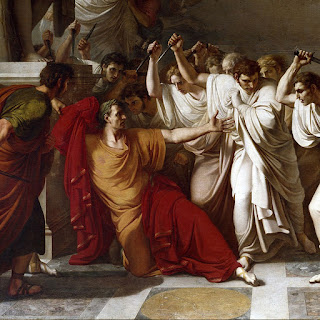
Marc Antony: “ Friends, Romans, countrymen, lend me your ears; “I come to bury Caesar, not to praise him. The evil that men do lives after them; The good is oft interred with their bones; So let it be with Caesar. The noble Brutus Hath told you Caesar was ambitious: If it were so, it was a grievous fault, And grievously hath Caesar answer’d it. Here, under leave of Brutus and the rest– For Brutus is an honourable man; So are they all, all honourable men– Come I to speak in Caesar’s funeral. He was my friend, faithful and just to me: But Brutus says he was ambitious; And Brutus is an honourable man.” [Worth noting, Gaius Julius Caesar was not an emperor; the successors who fought for absolute power and took his name as a title were emperors and brought about the death of the several hundred years of Roman Republic.] The American Republic is now at an end. We had a good run. He will be forced to concede, because Trump will not declare martial law....


Comments