Being the continuation of InstaPunk and InstaPunk Rules
The Secret Life of a Clouded Brain
Get link
Facebook
X
Pinterest
Email
Other Apps
Click on the pic. It leads to a post describing a Tom Hanks skit on SNL.
That’s what this post is about. More precisely, it’s about who this very
fortunate man really is under the greasepaint. He’s not James Stewart.
Have you clicked and read the story about Hanks pissing off half a country that’s always wanted to love him? The caption might be a little overstated, true as it is, but it’s only one of three things this post is about. Tom Hanks, sure. But also the fact that I’m thanking him at the moment for making me do some long overdue reclamation work on a piece that has been effectively lost for a couple years now. I’ll get to the third thing later.
The stupid Hanks performance reminded me that I had written a satirical piece about him that got effectively lost when one of my biggest blogs suddenly lost all its formatting in some administrative change by its provider, who were still billing me but could not be reached for troubleshooting services. They’d been acquired or merged or something, and the new larger organization could not be contacted in person anymore.
This is nothing new in my experience. Back at the turn of the century I developed a truly gigantic multimedia work called Shuteye Town 1999, which used one of Microsoft’s more brilliant innovations that enabled me to draw a complete world of my own design in a word processing program. It allowed me to put multiple hyperlinks into individual drawn objects that linked to other files, including text and sound files. Then Microsoft issued an “update” that automatically replaced the program version I’d built my project with. It became inaccessible even by the program that made it. A brilliant volunteer undertook the task of converting the original files and links to HTML, which saved the work but at the cost of links to text and sound files. This was hurtful in three specific areas, two of which were resolved by breaking out lost files into print and/or Kindle books of their own (The Zeezer Bible and The Lounge Conversations). The third I desperately wanted to find some way to fix myself, because it was so involved in the smooth functioning of a major point of focus in Shuteye Town.
I built a website for the new HTML version of Shuteye Town, which preserved it for several more years, until what had been a free website, then a paid one, suddenly shut down completely in 2022 with only a couple weeks notice. What I now had left were the HTML files, and enough screen shots of the lost website to help me build a new Shuteye Town site at Blogger. I’m still working on that with promising interim results, but it’s not ready for Primetime yet. Then I got another crippling blow. The blog that had been the repository for both the HTML and text files making up ST99 suddenly lost all its formatting along with a lot of graphic content. And there was nobody to tell, no obvious corporate entity to contact, since the names and players of the owners had all changed and rolled to permanent voicemail.
If it sounds like I’m complaining, I’m really not. I plighted my troth as a writer to computer technology more than 30 years ago, and it is that technology which has enabled me to do works far beyond what I dreamed of when I first started pounding the keys of my old Underwood Standard Typewriter (also lost to time and life, like the cardboard box of my early writing thrown away by my first wife during an unpleasant divorce, the works lost to sudden disk crashes over the years, the only photo of the original TBB manuscript eaten by a Scottish Deerhound puppy, the sequel to ST99 — already ten times the data size of the original — in a never diagnosed viral infection of my PC, and the usual casualties of a life that has involved many moves and their inevitable mysterious disappearances, like the bound volume of the corporate management publication for which I won a national award in the business world…) What’s gone is gone. Life is always a process of loss as much as attainment. What rankles is the stuff that’s not yet lost but in grave danger of vanishing into the ether at any moment.
Are you starting to link the title of this post to me personally? I don’t blame you. But the piece I’m going to show you here has a unique story of its own that gives it a unique shape and meaning in my writing life. Shuteye Town 1999 had a bookstore. It contained hundreds of books and a secret room full of more books introduced by the only guide in town, an avatar named Daniel Pangloss. Moon Books was only accessible by clicking on the crime scene tape that blocked its doorway. Inside there were labeled shelves. The labels could be clicked on, disclosing books and many titles. Some of the titles could be clicked on to show front and back cover copy. Some of these could also be clicked on, leading to text excerpts from the books themselves. Of this subset of a subset of a subset there were more than 50 with linked text files.
Shuteye Town 1999 is a hologram. The first screen you come to owns all of it. Goes everywhere.
You don’t have to do this, but you can do this. Click on the graphic, you’ll enter the mall. Click the police tape to enter the store. Click on the Fiction category, and you’ll find one of the titles is “Shit, I’m Dying.” Click on this book and you’ll see the front and back cover. Click on this and something ugly happens. In the original version, you’d have seen the excerpt I wrote; these always trailed away at the end into my own form of Greeked text, borrowed from the “Aeneid.” In the HTML version it directed you to an error file at the blog site where all the ST99 files were stored. I discovered at the time that this error file was itself accessible for edit, so that it would be possible to provide access (awkward but workable) for visitors to all the book excerpts on this one page if I designed it cleverly enough. I worked and worked at this, for years, never happy with my technically troublesome workarounds, until I finally realized I owed readers more than the original brief text samples. Which put me back to work trying to make it worthwhile for them to do the work of finding the book they wanted from the more than 50 that were missing.
In a sense, this became a project that represented a sequel to the original, because the author IDs and the subject matter of the Moon Books inventory were still relevant now, and their subsequent experience reflected what I had been implying about them originally. I set about creating a context for each excerpt that also required a little effort by the reader to verify that he was where he suspected he might be in his book hunt, so that when the excerpt appeared it might produce its own “AHA!” moment. Along the way I also started from scratch to do the same for some of the titles in the store that had cover displays but no linked text (an irresistible if undisciplined temptation on my part). So here’s the book I sent you looking for on the “Fiction” shelf:
The book had nothing to do with Tom Hanks when I dreamed it up. When I started noodling a humorous context for it at a later date, I knew it would be even more difficult years later than it had been in 1999. For me the joke had never been AIDS, which was the reason the writer wrote his novel, but a literary trope I had always found laughable, which is the tendency I’ve observed in books, essays, and media appearances by gay men that male homosexuality is far more common than it is. It has seemed to me that maybe half the prep school novels written in the last 50:years have this as a subtext. The fact that the popular culture keeps laughing at jokes like the Monty Python lumberjack song may be reinforcing this erroneous belief (how many unfunny innuendoes have we heard about what hunters really do on their stag “camping” vacations…?) with no appreciation of the possibility that lumberjacks in dresses are just funny, not a sardonic clue to the biggest secret in western civilization. Never heard a gay writer acknowledge the likelihood of the “Pauline Kael Effect.” The New Yorker’s great film reviewer famously observed that she didn’t know anyone who had voted for Richard Nixon. Well, who did she spend all her time with? Nixon Derangement Syndrome had Manhattan café society as its Vatican. That was my motivation for the text I wrote for “Shit, I’m Dying.”
Now we live in the LGBTQ ascendancy, which has been building in momentum for many years now. Now, like the Spanish flu, the memory of a plague that produced appalling casualties in the gay community for reasons no one wants to talk about has virtually disappeared from public notice. AIDS is no longer a gay male disease but principally an artifact of intravenous drug use and no longer necessarily a fatal one. I should probably have let this title join AIDS in the memory hole and spend my time elsewhere.
That’s when Tom Hanks popped into my head. Whatever people remember about the AIDS plague that infected maybe a third of gay males in the United States they probably remember from the movie “Philadelphia,” Which earned Hanks one of his two Oscars, the other being for Forrest Gump (which I resisted seeing for a long time because I couldn’t imagine Hanks besting Peter Sellers in a reimagined version of “Being There”). The movie I really thought of after “Philadelphia” was “Joe and the Volcano,” a comedy I admired for its inspired portrayal of the darkest aspects of corporate servitude. The notion of a ‘Brain Cloud’ was a perfect metaphor for all kinds of impairments to human consciousness, one of which I think we witnessed in the SNL skit linked up top.
That’s how the piece shown below came to be. It got lost when the formatting crash at my blog site turned it into this:
But I knew it was still there somewhere. And I found it. I had all the missing graphics on my iPad. I located the text buried in the links shown just above, and I rebuilt it in Word and then moved it into Blogger. Why I’m saying ‘thank you’ to Tom Hanks. I’m glad you made me pissed off enough to find and restore this:
*******************
The Secret Life of Tom Banks
Posted on June 27, 2013 by RL
In the movie “Joe and the Volcano,” six time Oscar Winner Tom Banks starts feeling sick at his job in Philadelphia, no wonder, and goes to see a doctor, resulting in the scene above. His first response is probably a lot like yours or mine would be. He writes a novel about his rotten luck, using the nom de guerre Michael Hanrahan.
Hell to get AIDS. But a great way to get on the bestseller
list. I could get lucky. Ask my ghostwriter. Get it?
Shit, I’m Dying
Chapter One
I was getting restless. Bill Boggs was a friend from the days so long ago—exactly three weeks now—when I was also a broker, furiously peddling thick sheaves of paper that promised millions if the sky didn’t fall in. But the sky had fallen in, on me at least, and I knew I shouldn’t have shown such an early draft of my work to a straight, even one I liked as much as Bill.
“The thing is,” Bill said, the way the straights do, as if there were only one ‘thing,’ and they had it in the back pocket of their blue suit-pants, “You guys always seem to think that everybody famous was gay. It’s just not convincing.”
I reread the passage he was so riled up about.
<<“Speak for yourself, John,” murmured Pocohantas. She was a drab girl who continuously exuded a strong smell of deer meat. John Smith edged farther away from her. He didn’t want that scent of rotting venison on his suit with Miles Standish coming so soon for a visit. No, what he wanted was Miles Standish himself—and not in the company of this young woman, but alone, where he could sound out the possibility so subtly alluded to in their discourse, the possibility which had kept him awake nights dreaming of…
“John.” Pocohantas was patient but insistent. “John! Don’t you have anything to say to me?”
He turned back to her from his fevered imaginings. “Yes. I do. I feel you should know that buckskin is passé. It is no longer la mode. Do I make myself clear?”
“Yes, John.” And then she smiled that damned secret smile of hers, as if she knew. She didn’t know shit.>>
“It’s that last sentence, isn’t it?” I asked. “John Smith wouldn’t have said ‘didn’t know shit.’ You’re right. I’ll change it.”
Bill stood up, ready to return to the safe environs of his bulls and bears. “Sure,” he said. “That’ll take care of it. I’m glad to see you looking so healthy and energetic.”
“You don’t like my novel,” I said suddenly. A storm cloud I hadn’t seen coming was upon me, black and bursting with lightning, rain, and fury. “It just isn’t possible to you that we have always been around, right in the middle of things, keeping this big secret from all you dull, conventional, heterosexual mediocrities. You spend a big chunk of your lives trying not to see us at all, pretending we’re not there, and you get so good at lying to yourselves that you start thinking it’s some kind of modern fad that’s confined to a few streets and bars in New York and San Francisco. And that’s exactly the kind of narrow-minded, bigoted, delusional, bullshit myopia I’m trying to expose with my novel. And what’s more,” I screamed at him, my voice rising to a sibilant, glass breaking pitch, “I think you’re actually jealous, because while you’re stuck in that swamp of junk bonds and semi-fraudulent securities, I’m trying to do something important with the rest of my life.”
Bill waited impassively through the end of my tirade. “I know this is important to you, Edward,” he said. “I respect what you’re trying to do, and I wish you well. I really do. It’s just that maybe I can give you a helpful perspective from the other side, as it were. And as I think about it, what I’m trying to convey to you is that people in every kind of minority spend so much time thinking about the group they belong to, they wind up believing that everyone else is thinking about it all the time too, and if they don’t talk about it all the time like you do, then they must be suppressing something, or hiding something, or avoiding something. The dull truth is that dull, white, middle class guys like me spend hardly any time thinking about the lives of gays, or blacks, or women. Since we’re not gays or blacks or women, we spend most of our time thinking about what we’re going to do today and maybe what we’d like to accomplish next. So when you show me some scene with gay pilgrims or George Washington in drag, I don’t find it very convincing, that’s all. But you’re the writer. You’ll work it out somehow.”
After he left, I pouted for a while. Maybe there was something in what he said. Maybe. But then why had I seen that sudden rascal light in his eye that day when I accidentally came to work with the previous night’s mascara still in place? No. I knew my mission. I was going to blow the roof off the whole heterosexual lie before I died. That would at least make my death mean something. My death. Oh damn. That again. Frantically I sat back down at the word processor and … Arma virumque cano Troiae qui primus ab oris Laviniamque venit. Multa ille terris iactatis et alto. Dux femina facta. Forsan et haec olim meminisse iuvabit…
________________________________
We could leave it there, perhaps, but it seems kind of unsatisfying, doesn’t it?
UPDATE YEARS LATER…
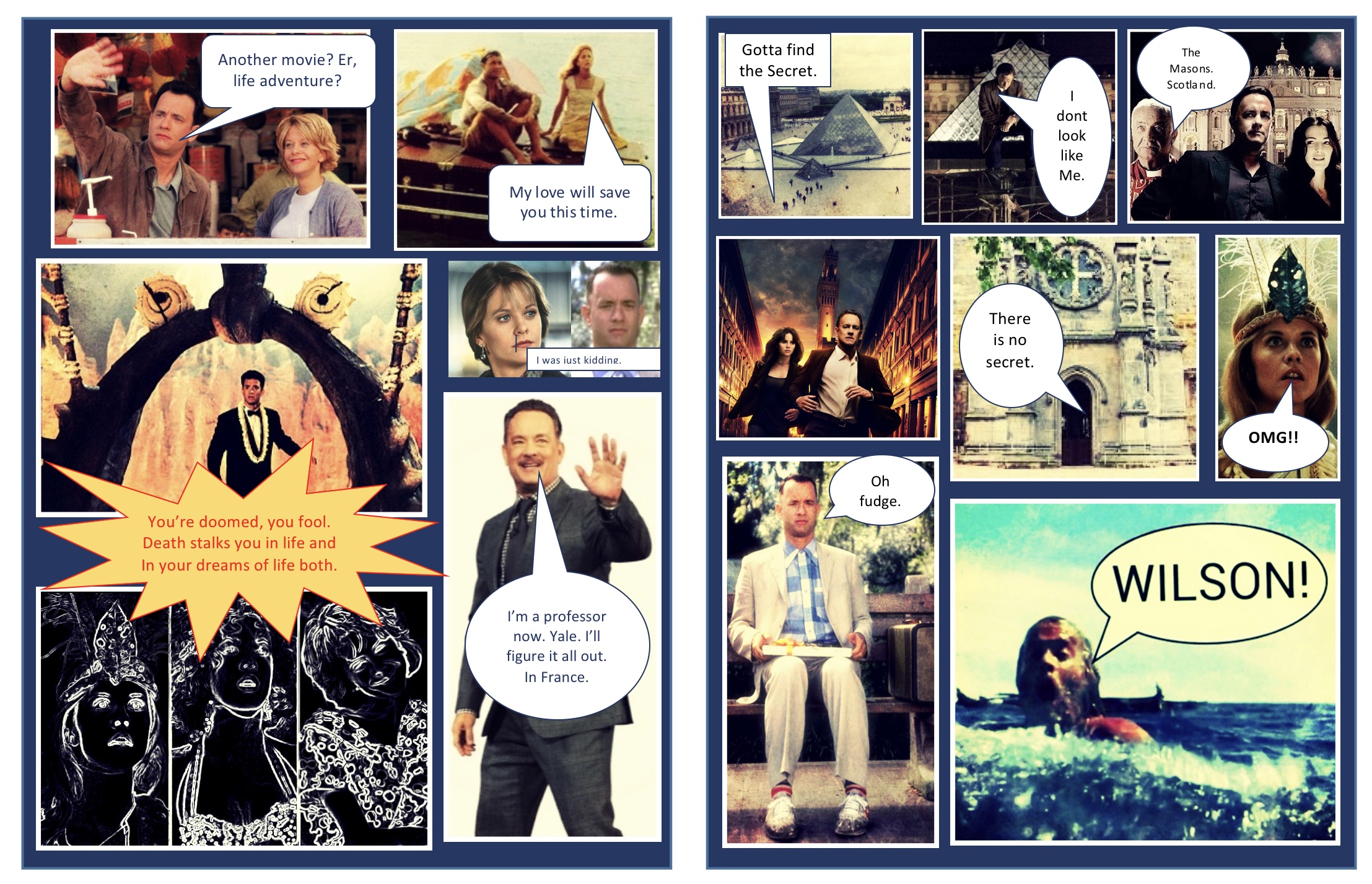
There was a second Hanrahan novel, this time an ambitious work in the graphic genre. In it he addressed his pain not just about death but about the difficulty of getting noticed in this world no matter who you are and how brilliantly you do what you do. It’s called “The Secret Life of Tom Banks” and we’ve excerpted it here for you as a bonus.
********************
Much ado about nothing much? Maybe. The act of putting together this graphic sequence required me to review the performances that made Tom Hanks so big at the box office. I’m old enough to remember what isn’t here but still influenced my decision to associate Hanks with this writing challenge. I saw him first in a comedy in which he starred with someone (who didn’t reach superstardom) as a pair of guys who move into a women’s apartment block and must pretend (à la “Some Like It Hot”) to be women, doing half their scenes in drag with plenty of winks at the TV audience. It was funny but a one-joke show that quickly grew old. I really liked his performance in a romcom called “Volunteers” where he played a spoiled Yalie on the run (in black tie no less), who sneaks aboard a charter flight bound for Peace Corps duty in Thailand. He did such a good job, I thought of him afterwards as a spoiled but charming Yalie, slumming in the movies with the same panache he showed after his 24 hr flight to Thailand when, after being turned down for sex by his oh-so-serious but blonde seatmate, he quipped, “Well, you have to admit, I’ve put in the hours.”
And he has put in the hours. His reputation rests on movies in which he plays men in extremely demanding life circumstances: the corporate glunk who is maneuvered into becoming a pagan human sacrifice in “Joe and the Volcano,” the attorney dying of AIDS in “Philadelphia,” the mentally challenged Being There clone who lives through the equivalent of what a critic of some war miniseries called ‘Close Encounters of the Most Convenient Kind,’ the reluctant hero of a bizarre World War II suicide mission designed to save the last surviving son (Matt Damon of course) of a heroic family, the victim of a capricious God who strands him all alone on a desert island with nothing but a soccer ball for company, the widower who conducts the most improbable against-all-odds romance since Cary Grant’s “Affair to Remember” in “Sleepless in Seattle,” and the brilliant college professor who doubles as cryptographer and swashbuckler in the ever-less-credible franchise written by Dan Brown. What enables Hanks to carry off these roles is that people believe they see in him some quintessential Americanness that grounds his character no matter how bizarre the premise and the plot may get. People speak of him as if he were a kind of Jimmy Stewart, the star who transcends every role by being, somehow, always himself.
I don’t see that in him, have never seen that in him. If there is an actor who embodies the iconic presence of a James Stewart it is not Hanks but (ironically) his costar in “Philadelphia,” Denzel Washington. It’s a simple but incredibly rare quality, the abiding sense one gets of decency. Easily provable in the case of Jimmy Stewart. Virtually alone of all American movie stars, Stewart fought for real in World War II, piloting a B-17 in the most dangerous air combat of the war, restarted his career when he got home, married a woman he stayed married to for the rest of his life, was an unashamed patriot even after he lost a son in combat, wrote funny self-deprecating poems to recite on the Tonight Show, and deserved more Oscars than he got in a career that included what some critics rank as the best of all American movies, “Vertigo,” as well as the signal laurel of being the only actor besides Cary Grant to star in four classic Hitchcock films. As well as the John Ford classic western Clint Eastwood mirrored darkly in “Unforgiven.” Denzel Washington also exudes decency in his own impressive variety of roles and life credentials.
Tom Hanks though. There’s a difference between playing a man in dramatic, dangerous, equivocal, or even supernatural circumstances and playing John Q. Public with a survival problem, a comedic dilemma, a handicap, a military uniform in a glamorous theater of combat, or an advanced degree in a glamorous foreign capital. What’s the difference? Hard to put a finger on it. Just felt it.
Now I know it. Tom Hanks has just proven that he is not a living embodiment of Americanness. He is just another spoiled, half educated movie star who knows next to nothing about the countrymen who have made him successful at the box office. He will be remembered for this for the rest of his life. Count on it.
I don’t know what all this tells you about the mission of the satirist. He’s supposed to find a perspective that makes the inauthentic look inauthentic, the dishonest look dishonest, and the fake look ridiculous. At a minimum, he’s supposed to ask questions that need asking and then ask his readers to do their own math.
This time, the Academy Award goes to the soccer ball.
It strikes me now and again. Can’t help it. Just try to control it… I’ve only done one thing: That’s all. I swear. Okay. Couldn’t help it. But’s that’s all. Really. I was working on my long postponed post about the best movies in the first 25 years of the 21st Century when this overpowering sense of ennui overcame me, and dissing the movies suddenly struck me as more important than debunking the big lies mass media tells about itself. Working my way through it… P.S. An old friend just checked in with an enhancement of my comic cover that blows mine out of the water. Couldn’t resist sharing it with you all. ________________________ Below the Fold What I had of the new/old post I was trying to finish: Keeping My Promise about the Best 21st Century Movies It’s that time of the year when movies are back in the news more than usual. The recent Oscars broadcast was chiefly notable for its record-low viewership, inane political rhetoric from the podium, and a crop of...
We, of course, were as offended as anyone by the President’s evident pleasure in being depicted as Creator of the Universe. His later insistence that it was just a plate of food that happened to have blond hair was disingenuous to say the least. There. That’s out of the way. Putting aside all the bluster about blasphemy by secular observers whose relation to religion is probably a checkbox item, I believe there is a real story lurking in all the feigned outrage. a neon flash of double standards. It’s a media story, probably meaningless to those who aren’t ancient enough to have witnessed Obama’s first year in office. He was kind of everywhere, on every news interview program, every newspaper headline, and every magazine cover. (For the youngsters in the audience, there used to be things called magazines with words and pictures in them. It was a big deal to be featured on their covers.) If you weren’t a big Obama fan — and maybe even if you were — this got to be kind of sickening a...
Here’s the story that’s running at the righty news outlet called National Pulse. Here’s what they think we need to know: Sufficient for us to know he’s a “Biden Judge.” What if the lead graphic of their post had looked like this instead? See, they kind of left out the most sinister background of this story, which goes far beyond a medical issue, however grave it is to those involved. National Pulse fails to see that our real concern should be the supine role played by Congressional Republicans in enabling this man to be seated on a federal bench. For once, it is truly important to read the entire Wikipedia entry about this man, which is alarming even in the prose of the far-left leaning site that published it: <<Mustafa Taher Kasubhai (born 1970) is an American lawyer who has served as a United States district judge of the United States District Court for the District of Oregon since 2024. He previously served as a United States magistrate judge...
I first heard of Meidas Touch shortly after I joined ‘X’ in the wake of Musk’s takeover of the poisonous lefty site called Twitter. The lefties continue to be a dominating presence there, and even when freeloader Citizen Free Press links a decent post there, the first one or two replies at least are screeds by the kind of crayon-armed haters who want all Republicans assassinated. CFP loves to indicate that outrageous lefty posts are ‘buried’ or ‘destroyed’ by MAGA derision, but this is usually an overstatement. Why I was occasionally moved to reply to the worst of them. The Meidas Touch editor Filipkowski was one of the first to tempt me to. After a quick review of the MT site, I told him it was the most egregious pile of vile libel made up completely out of whole cloth I had ever seen. (A permanent sidebar there declared that there are over 20,000 pending lawsuits against Trump for a variety of sex crimes.) I told him he was a disgusting cancer on the corpse of journalism that was sti...
Lewis Hamilton wins Seventh World Championship at Formula 1 Grand Prix in Turkey: A stunning drive from Mercedes’ Lewis Hamilton in the Turkish Grand Prix gave him his 10th victory of the season – and, more crucially, saw him claim the seventh drivers’ title of his career, to equal the record of Michael Schumacher, as Racing Point’s Sergio Perez and Ferrari’s Sebastian Vettel completed the podium after a thrilling race in Istanbul. Hamilton had started the race in sixth, risen to third midway through the first lap and then dropped back to sixth by the end of Lap 1 after an error at Turn 9. But a decision to change his intermediate tyres just once saw Hamilton drive a masterful race to claim victory by over 25 seconds from Perez. The win alone was enough to claim championship #7, but it was even more assured after a disastrous race for Valtteri Bottas - the only man who could have stopped Hamilton winning the title today - who spun six times en route to a P14 finish.
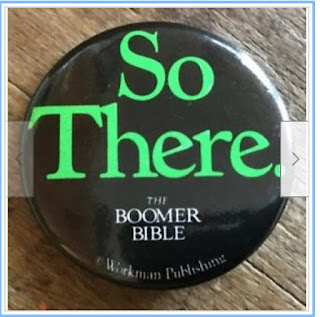
*I’ve* never even had one of these. I’ll leave this one for one of you guys. Plenty of time to get this before Christmas. Here’s the EBay proffer for what’s called the ‘Pinback Button.’ The cute graphic treatment even includes the pin side. It you actually want to read a physical book that you can hold in your hands, put on your shelf, or give to some friend or family member who’d like to understand what happened to the Great American Experiment you can find a copy quite easily, still in time for Christmas, via the following retailers and others. Just search the ‘Shopping’ tab at Google for “The Boomer Bible” and you’ll find it. (If you’re viewing this on a tablet, you can read this graphic more easily by clicking on the pic and turning your device 90 deg counterclockwise.) I don’t make any money from your purchases obviously, but I feel like I’m doing a public service in showing you what’s out there. For example, here’s something that’s out there I hadn’t actually found till yesterday...
Hot Videos of the Week New York Post: Why Kentucky Derby Disqualified Maximum Security in Stunner CNN: Plane Skids off Runway into River News Busters: Medley—Blaming Trump for Terror Attack and Paving the Way for Pete and Joe PLUS: ABC Can Barely Speak of 50 Year Low in Unemployment Desmoines Register: Elizabeth Warren Campaign Even Disrupted by Animal Rights Protest C-Span: Senate Judiciary Chair Lindsey Graham Reacts to Barr Hearings ABC News: House Judiciary Chair Gives Ultimatum to A.G. Barr, Could Charge with Contempt Breitbart: MSNBC Panel—‘We Can Handcuff People Who Ignore Subpoenas Media Research Center: Tutorial on Media Bias [ bkgd ] CNN/Van Jones: Chelsea Handler—Trump Was a Personal Trigger for Me Power Line: This Week in Pictures—Close Down the Barr Edition VIDEO ARCHIVE BONUS: New York Daily News: Inside Old Abandoned City Hall Station _______________ Ed. Not...
Today’s Hot Headlines: NY Daily News: Vaccinate All Kids—Rockland County Exposes a Weakness in NY Public Health Detroit News: Trump in Michigan—‘The Collusion Delusion is Over’ The Epoch Times: Spygate—The Inside Story Behind the Alleged Plot to Take Down Trump The Week: Joe Biden’s Endless Gaffe-Riddled Apology Tour Newsweek: John Brennan Spokesman Says Trump Defenders Are Failing to Accept Reality Washington Post: The Trump-Russia Collusion Hall of Shame Breitbart: Limbaugh—‘They’re Setting Up the Impeachment Now‘ New York Post: Mexico Warns, Mother of All Caravans Headed to United States CNN: Fact-Checking Trump’s Michigan Rally The Babylon Bee: Stopped Clock Named CNN’s Most Accurate Reporter
A good catch by my wife is what started all this. As is our usual habit, we were watching something on TV older than the foul-mouthed, stunt-casted contemporary dreck when it rolled over into another older show called Grimm . I had heard of the series, maybe even seen some of it when it ran originally, and so we gave it a go. In the opening sequence our protagonist sees a young blonde on the sidewalk and as he watches her pretty face changes momentarily into a twisted monster version of her. Then it disappears and she goes to her car and drives away. That’s the premise of a show that ran for six years starting in 2011. The man who sees the transformation is, unbeknownst to him, a descendant of the famous Brothers Grimm who hunted down the monsters found in fairy tales. Here’s the scene I was able to capture later: Clumsy screen grab. Sorry. Don’t tell anybody. When the blonde woman did her quick change and vanishing act, my wife laughed and said, “Who knew that Pam Bondi started ...






Comments