Being the continuation of InstaPunk and InstaPunk Rules
Some Scary New Initials to Start Flinging Around — MMH
Get link
Facebook
X
Pinterest
Email
Other Apps
Are we being distracted from the real problem? This is a fairly typical posting from the right-leaning media…
FTA: <<Liberal celebrities and entertainers love to get preachy with the public. It’s almost like it’s coded in their DNA. They just can’t resist it.
One public relations expert recently said that the public is sick and tired of it. People want to be entertained, not lectured to.
He used two specific examples. Bruce Springsteen and the Black Crowes. Springsteen’s concerts have become more like liberal talk radio and the Black Crowes actually had audience members walk out on them for trashing the USA.
Doug Eldridge, the founder of Achilles PR, says people have had it with this.
“At this point, it’s fatigue,” Eldridge said.
“Much like compounding interest, it’s not a linear calculation; it’s accumulation,” he continued. “For the last decade, fans (read: average Americans) have been lectured, lied to, gaslit, and shamed, if they didn’t conform to the new standard du jour.”
“Worst of all, if you didn’t buy into the ’new normal’ you were castigated with an -ist or -ism as being the reason for your non-compliance,” he added. “At a certain point, Americans had enough — the same way they vote with their feet in elections, they vote with their dollars in the free market; especially for non-essential items like entertainment.”
“Most Americans don’t mind that you have a different view; what they resent is being lectured and chastised for having an opposing view from the very act they paid good money to see,” Eldridge said. “For Springsteen, the incessant criticism of Trump seems paradoxical, given his highest grossing album of all-time, was the iconic ‘Born in the USA.’”
Liberal entertainers are just like anyone else who suffers from Trump Derangement Syndrome. They simply can’t not talk about it. It’s the only thing they want to talk about at all. They need constant reassurance that other people agree with them and also hate Trump.
When they don’t get the reaction their seeking, they are usually stunned and angry.
They’d sell a lot more tickets if they’d just knock it off, but they simply can’t do it. It’s like a compulsion.>>
What’s the takeaway here? This is a problem liberal entertainers have because they’re spoiled narcissists who can’t see when their Hollywood-acceptable rantings are just pissing of the people who buy the tickets. The good news. People are getting sick of it. Not buying the act anymore. In time, the market will force them to back off and lower the incendiary rhetoric? Either that, or their careers will crater for good.
Except that it’s not true. It isn’t the liberal celebrities who have the dangerous problem. It’s us, the American people.
Social engineers have long been accomplished at using celebrity excesses to reduce negative mass responses to a variety of sins. Stars of stage and screen get publicly embarrassed for infidelity, domestic violence, substance abuse, drunk driving, gross sexual misconduct, shady or criminal pre-celebrity pasts, family-destroying bankruptcies, and even various categories of child abuse. And once the TV evangelists have condemned them, the world they occupy gradually rehabilitates their images and careers by reminding the public that these kinds of sins are just human beings being human, and we should quit being so effing judgmental. Then comes the surprise Oscar or the new spouse “who helped me turn it all around.”
This has become so routine in the entertainment world that it’s hard to identify moral boundaries that really can’t be crossed with eventual impunity, and the moral compass of everyone drops another notch or two.
With one important category of exception, celebrities aren’t the problem here. Kathy Griffin is not going to cut Trump’s head off. Robert De Niro is not going to take him behind the barn and beat him to death Jake LaMotta style. The effete Mr. Ruffalo is not going to go all huge and green on him and stomp him flat on a Manhattan street. Just as they are only heroes when posing in front of a green screen, most of these are just celebs on the down side of their careers willing to go to any lengths to feed their starving egos.
The problem category is that celebs are part of a media environment that has been fine-tuned to dial up the violence regarding Trump and the people around him.
Unlike most of the people I see parading their memes and condescending one-liners on Facebook, there’s a whole world of other distinctly lowbrow sites overflowing with people who sound exactly like Bruce Springsteen, Robert De Niro, Rosie O’Donnell, Ellen Barkin, Mia Farrow, and Kathy Griffin. They are impervious to logic, factual rebuttals, proofs of AI fraud in photos and videos, and there has never been an accusation against Trump so over the top that they don’t believe it fanatically the first time they hear it.
This is mental illness, and the pot is coming to a boil. I asked the Collins Dictionary people for two definitions.
Sound pretty mild, does it? Also vague. Professional psychologists don’t like these words anymore because they have replaced them with others, not because there is no serious mental illness associated with the behaviors alluded to. I asked Google’s AI chameleon for more information about these outdated terms. First up? Mass Hysteria.
That’s the gobbledegook version. Here’s a more plain English description.
What do I get from these quotes? Women more affected than men. Certainly consistent with my own experience at the Threads website. The same accusations made by the same people every day, testimony to the fact that the mere sight of the President produced physical symptoms of nausea, palpitations, etc. Also, the process of adapting professional perspective on mass instances if identical antisocial behavior hasn’t made the leap to considering the immersive social network environment as its own kind of closed community. Not a town square in 16th century Europe where a dancing seizure breaks out. The symptom set of a mass seizure in a faculty lounge or some “influencer” website might be very different from medieval outbreaks. There doesn’t seem to be any research in the direction of identifying the attributes of “communities” that are, or might be, vulnerable to mass hysteria in the 21st Century. Same problem with defining what ‘trigger’ event might be for the isolated ones, however defined.
The response concerning monomania was interesting in that it didn’t want to use the word in a headline. But far from claiming the malady didn’t exist, they provided some explanation about how a very real mental impairment was being rebranded by official science:
The terms being bandied as Modern Equivalents now in the monomania context include OCD and ADHD, both of which ailments have increased very dramatically in recent years. OCD because it is associated with what’s now called the ‘spectrum” of autism. No word on whether OCD is actually being used to formalize a diagnosis of mild autism. What we do know for sure is that we have more of it now. ADHD is also intriguing in this context. I recently heard that 1 in 10 elementary school age boys is being diagnosed with ADHD, though some skeptics suspect that medications to treat ADHD are being used to sedate mischievous boys in class. (Interesting the problem boys in the curriculum doesn’t seem to be on the list of treatments.) The second category of Modern Equivalents reads like a pretty perfect definition of anti-MAGA, anti-ICE protesters.
As a big fan of the guy shown in the tiny photo at the bottom right of the screengrab, I had this reaction…
This is the article linked by the AI post above. Its importance to the author seems to be that Poe had a better idea about what monomania was and how it might be catalyzed and used than the contemporary profession of psychology does in 2026.
Here’s the heart of what most concerns us here.
:
Joan Burbick discusses the condition in relation to Edgar Allan Poe, using a simplified, modern interpretation of it as “an obsession with a single object.”5 The issue with this definition is that it neglects monomania’s initial existence as a form of “partial insanity”6 as it first appeared as a “psychiatric diagnosis in France in the 1830s and 1840s.”7 Monomania has been compared not only to obsession but also to paranoia and indolence. Poe, however, seemed to have a profound awareness of the term’s incomparability.
In Berenice8 (1835), the word “monomania” features for the only time in Poe’s work, as a self-diagnosis of the narrator’s irrationally obsessive mind. Robert J. Belton discusses how Poe’s narrator labels his ailment “as monomania, an old psychological term for what now is called paranoia.”9 Belton’s comparison of monomania to paranoia adheres to the problematic oversimplification of its modern denotation (obsession with a single object), yet this insight acknowledges monomania as a mental disorder as opposed to a mere obsession. In Berenice, the narrator describes his monomania as “morbid irritability of […] the attentive.”10 This corruption of attention forms the basis of monomania in all contexts, particularly “to muse for long unwearied hours with […] attention riveted to some frivolous device.”11 Poe acknowledges the importance of the obsession being tied to an otherwise ordinary object. Moreover, the narrator in Berenice describes a “nervous intensity of interest.”12 Whilst nervousness alone is not indicative of partial insanity, it holds connotations of paranoia, thus Belton’s understanding of monomania as paranoia, despite the fact that they are not entirely the same, resurfaces here. Poe’s narrator confesses that in these musings, it is “more than probable that [he is] not understood.”13 The lack of understanding and logic associated with the narrator’s monomania, in addition to the nervousness of his temperament, leads to the conclusion that the generalized, modern definition of the term as merely an obsession with a single object neglects much of this intriguing condition’s profundity, which Poe understood.
Poe theorizes that within the realms of short fiction, any skillful writer should conceive of “a certain unique or single effect to be wrought out […] he then combines such events as may best aid him in establishing this preconceived effect.”26 Poe claims to write focused tales with a single, commanding function, which lends itself to a monomaniacal style. If Poe indeed views short fiction writing as something that flourishes when it maintains a narrow focus upon a single effect, it would provide an explanation for Joseph Krutch’s opinion of Poe, claiming that “When he fails it is usually because he has attempted something outside of his narrow range.”27 Whilst Krutch’s view has been bred within psychoanalysis, Poe’s narrow range does not seem to reveal anything about his own mentality. Instead, monomaniacal writing simply fits the build of an effective short story for Poe, achieving a single effect to be maintained throughout the story, allowing him to keep hold of and subtly induce his desired effect upon the reader by ensuring the existence of what “is rightly termed by Schlegel, the unity or totality of interest.”28 To ensure a totality of interest, the unified effect must be maintained throughout the reading experience; monomaniacal writing that incorporates a narrow range alongside obsessive narrators allows this effect to be realized, suggesting monomania is not only a specific form of partial insanity but also a tool.
What do we get if we put some this psych lingo together and look at the subject with a completely modern perspective? There is always a large population of the ones who can’t find someplace to belong. They are dissatisfied with their lives, bored, resentful, envious, and as hungry for excitement as they are for attention.
What if infecting large numbers of people with monomania (what better distraction from the ‘ick’ surrounding you?) could be achieved for the purpose of precipitating seizures of mass hysteria. Creating a bunch of monomaniacs obsessively focused on the same target could cause a riot or inspire an assassination.
How would one do that? The way Poe described. By using monomaniacally focused communications to achieve an oversized response in the reader/recipient. Set a monomaniac to catch a netful of monomaniacs and turn them into a mob or a hit squad. It was Poe who used the word ‘tool’ in this context. He did use words that way. But he couldn’t reach a hundred thousand bored ne’er-do-wells with the right message from his breakfast table, or the right concentrated stream of invective aimed at one person for 10+ years.
The Alphabet News networks are Edgar Allen Poe writing short fiction with monomaniacal tools to nail down that “unifying totality of interest”. The celebrities are the country club version of the same team, on the same side, for any number of reasons.
What I’m calling Monomaniacal Mass Hysteria was not possible on the scale we’re starting to see it now. It’s a home wrecker. And a nation wrecker. We are the target, not of the celebrities but of the hundreds/thousands of monomaniacs building their teams of thousands/millions of monomaniacs. Which takes you directly to you-know-what.
If you want to pursue the Poe perspective on monomania, which is a real phenomenon, here’s the best way. Read what he wrote about it.
The article linked above argues that Poe understood monomania was not simply a ‘partial insanity’ but a more profound and pervasive illness in which specific fixations infect the entire personality and its thought processes.
Helpfully, Poe wrote at least three stories showing us what the full-blown mental affect looks like:
As always, have fun, but think about it while you’re doing that. One of many extraordinary attributes of Poe was his ability to infect others with his obsessions, even in the realms of visual arts and music. Here’s a classical music tribute to Poe’s poem “The Bells.” Ever heard an orchestral arrangement of Finnegans Wake?
The last group photo I’m a part of that’s still in my possession. My sister’s wedding in the late1990’s, with me and my mother in attendance, here in Salem. I don’t get out much anymore. Haven’t for a long time. If I didn’t take pictures of myself, nobody would, or could, anymore. I don’t give them the chance. Why in recent years I’ve made a point of doing an official birthday selfie, to keep track of the wear and tear of the years and see if the falling apart process is gaining speed. This year was not a good year for hair. That much I’ll tell you. But here’s the Official 74th Birthday Selfie I took on Friday. Not as young as I used to be. I hadn’t really shown this pic to anyone, but imagine my surprise when I received a gift yesterday by parcel delivery from a young lady I helped raise who will always be close to my heart. She and I hadn’t spoken about the Rolling Stones in years, but somehow she must have divined I’d been thinking of them, because here’s what she ordered sent ...
This is what I call an omnibus post. That is, it will contain many links to what I have published here and elsewhere previously. Not going to apologize for that. I don’t mind asking you to read a variety of approaches to the same gigantic topic. It’s a tooic so big we’ve all become accustomed (or trained ourselves) to deal with it only in pieces. But the pieces are all part of a larger whole that has grave consequences for the cukture as a whole. A great many people aren’t going to like what I have to say here, but it’s time it was said. I won’t be mincing words. If you feel like contending with specific points I am making, you’re well advised to read what’s at the links before you cut yourself the easy break of dismissing this post as irrational or wrongheaded or over-generalized. It isn’t. It just won’t be popular. A word about the word ‘general’ as it used in vernacular expressions like ”in general” or “generally speaking.” We all do generalize, mostly without acknowledging that whe...
If you’ve never seen an Asylum production of their “Saving the World from Imminent Destruction” series, you’re excused from this post. The rest of us already know the basics. A once prominent, now disgraced scientist (often Sam Baldwin, but not always) is minding his own business making a living income and trying to mend his struggling family life when he notices that something is seriously amiss in the cosmos. Gravity isn’t working quite right. Or all the birds seem to be migrating at the same time. Or some local pond suddenly ejaculates a pillar of lava. You know. The warning knell of an extinction-level catastrophe. Meanwhile, where are the kids? They were supposed to be home by now. He calls his ex-wife. She doesn’t know where they are. He calls an old colleague at the agency in DC where nobody else will take his calls anymore. In a whisper, the colleague tells him the experts in charge haven’t noticed anything to worry about cosmologically speaking. This far in, we already know wh...
Invocation of Nemesis by the Summoners Click on Rosie. Thought I’d get this part out of the way right up front. I’m reminded of Oscar Wilde’s famous quip about the upper class British sport of fox hunting: “The unspeakable in pursuit of the inedible.” As it happens, I’m working on two different posts at the same time this morning. This one and another one about the sad PR plight by the unfortunate middle child of the three worst First Ladies in American history. . What the posts have in common is that the dominating element of both stories is a function of female psychology and can only be understood in those terms. There’s also the irony that Wilde’s jibe can be applied with some justice to both predator and prey in the two posts. Because I’m going to admit at the outset what most of the MAGA faithful won’t. You are right that Donald Trump is responsible for much of the imminent danger we are facing as a nation. Without his arrival on the political scene 11 years ago, the...
Happy Independence Day No. 250! I’m planning to do my part for the year-long celebration of the still remarkable birth of the United States of America. Just starting to realize that the number of us who remember the last big anniversary in 1976 is getting smaller every day. Why I have some special ideas about focusing on the moment of transition, that is the tick of the clock last night when the 249th year became the 250th. A kind of time capsule that may be buried now but dug up later to see who were way back when you were still as young as you think you are now. My credentials for the job. Quite a few actually, but the most important one today is that I was a working participant in the official Bicentennial celebrations back when I was still young. I wrote a post about it almost 10 years ago, ancient history in today’s 24/7 chronometer dial. In honor of the ones no longer with us from that time, I dug up the old post from the Wayback Machine and put it back together here a...
The Valley of the Jerseyikes When you’ve decided to your own satisfaction that life doesn’t end with physical death, what have you got to worry about? That probably depends on where you come down on the age-old questions about ghosts. Do they exist? Are they a possible fate of troubled souls after they’ve shuffled off this mortal coil or been yanked out of it too suddenly? What if you expire peacefully and find yourself waking up in the attic of your own house, somehow tethered to it with no watch you can trust to keep track of time? I know I’ve stopped wearing a watch at all, like almost all of you out there. Are we taking some kind of risk that we’ll miss the departure signal for the trip to the other side? One side effect of getting old and not liking most of what’s on teevee is that you wind up watching too many paranormal shows, which have the virtue of no politics, no gratuitous sex scenes, and extended stretches of restful watching with almost nothing happening on screen. ...
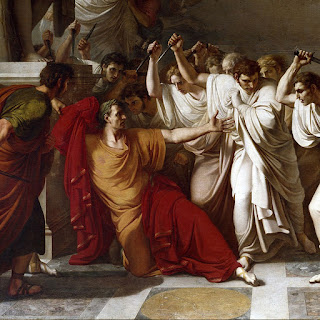
Marc Antony: “ Friends, Romans, countrymen, lend me your ears; “I come to bury Caesar, not to praise him. The evil that men do lives after them; The good is oft interred with their bones; So let it be with Caesar. The noble Brutus Hath told you Caesar was ambitious: If it were so, it was a grievous fault, And grievously hath Caesar answer’d it. Here, under leave of Brutus and the rest– For Brutus is an honourable man; So are they all, all honourable men– Come I to speak in Caesar’s funeral. He was my friend, faithful and just to me: But Brutus says he was ambitious; And Brutus is an honourable man.” [Worth noting, Gaius Julius Caesar was not an emperor; the successors who fought for absolute power and took his name as a title were emperors and brought about the death of the several hundred years of Roman Republic.] The American Republic is now at an end. We had a good run. He will be forced to concede, because Trump will not declare martial law....
The big historical questions of “What will happen?” are usually best settled in hindsight. The biggest questions generally concern whether or not some historical catastrophe was inevitable or not. The American Civil War. World War I. World War II. Meticulous historians, back when we had them, have given us answers to those three in particular. Yes, yes, and yes. The one that bears the strongest resemblance to our current turning point is our own American Civil War. The young constitutional republic had been born with a deadly contradiction at the heart of its founding documents, the Declaration of Independence, the Constitution, and the Bill of Rights. The reason for the contradiction was political compromise needed to secure sufficient nationwide support for the adoption of the Constitution. Slavery was a ticking time bomb from 1789 on. Eventually there would have to be a reckoning. Was actual warfare inevitable though? Yes. North and South were unified by their shar...
The CHYOS Club (Pronounced kīos, abbreviated ‘kos, meaning MR ) American Illuminati? We’ve all heard the legends of secret societies. The Renaissance story of the ‘Illuminati’ who rule the world as gray eminences behind the scenes is a legend unsupported by facts or, at any rate, evidence. We also know of outright hoaxes widely believed in, like the Priory of Sion made famous by admittedly fictitious Dan Brown novels and movies. But we also know that there are secret societies at every level of elite life. Who hasn’t heard dark whispers of Yale’s Skull & Bones, numbering the Bushes and John Kerry as members? At the international level, the Freemasons are a proven fact, even if their Illuminati-like influence is only widely believed in the UK, with its historical paranoia about Scotland, where freemasonry re-emerges as a follow-on to the Knights Templar. Great fun, mostly. Who doesn’t thrill to news about Bill schmoozing in the dark at the Bilderberger Group? Conspiracy? All t...




Comments